Vnc Remote Desktop For Mac
To share your Mac with someone else, download a remote Virtual Network Computing (VNC) app like Jump Desktop. With full remote access and Mac remote control, the other person — or yourself connecting to another Mac — can have the same level of control as the person using that device. Except for Admin level access, since it's password protected. See full list on wikihow.com. The original and best for remote access across desktop and mobile. VNC® software enables you to remotely access and securely control your desktop or mobile device. Your computer whenever and wherever you need it.
In computing, Virtual Network Computing (VNC) is a graphical desktop-sharing system that uses the Remote Frame Buffer protocol (RFB) to remotely control another computer. It transmits the keyboard and mouse events from one computer to another, relaying the graphical-screen updates back in the other direction, over a network.[1]
VNC is platform-independent – there are clients and servers for many GUI-based operating systems and for Java. Multiple clients may connect to a VNC server at the same time. Popular uses for this technology include remote technical support and accessing files on one's work computer from one's home computer, or vice versa.
VNC was originally developed at the Olivetti & Oracle Research Lab in Cambridge, United Kingdom. The original VNC source code and many modern derivatives are open source under the GNU General Public License.
There are a number of variants of VNC[2] which offer their own particular functionality; e.g., some optimised for Microsoft Windows, or offering file transfer (not part of VNC proper), etc. Many are compatible (without their added features) with VNC proper in the sense that a viewer of one flavour can connect with a server of another; others are based on VNC code but not compatible with standard VNC.
VNC and RFB are registered trademarks of RealVNC Ltd. in the US and some other countries.

History[edit]
The Olivetti & Oracle Research Lab (ORL)[3] at Cambridge in the UK developed VNC at a time when Olivetti and Oracle Corporation owned the lab. In 1999, AT&T acquired the lab, and in 2002 closed down the lab's research efforts.
Developers who worked on VNC while still at the AT&T Research Lab include:[4]
- Tristan Richardson (inventor)
- Andy Harter (project leader)
- James Weatherall
Following the closure of ORL in 2002, several members of the development team (including Richardson, Harter, Weatherall and Hopper) formed RealVNC in order to continue working on open-source and commercial VNC software under that name.

The original GPLed source code has fed into several other versions of VNC. Such forking has not led to compatibility problems because the RFB protocol is designed to be extensible. VNC clients and servers negotiate their capabilities with handshaking in order to use the most appropriate options supported at both ends.
As of 2013, RealVNC Ltd claims the term 'VNC' as a registered trademark in the United States and in other countries.[5]
Etymology[edit]
The name Virtual Network Computer/Computing (VNC) originated with ORL's work on a thin client called the Videotile, which also used the RFB protocol. The Videotile had an LCD display with pen input and a fast ATM connection to the network. At the time, network computer was commonly used as a synonym for a thin client; VNC is essentially a software-only (i.e. virtual) network computer.[citation needed]
Operation[edit]
- The VNC server is the program on the machine that shares some screen (and may not be related to a physical display – the server can be 'headless'), and allows the client to share control of it.
- The VNC client (or viewer) is the program that represents the screen data originating from the server, receives updates from it, and presumably controls it by informing the server of collected local input.
- The VNC protocol (RFB protocol) is very simple, based on transmitting one graphic primitive from server to client ('Put a rectangle of pixel data at the specified X,Y position') and event messages from client to server.
In the normal method of operation a viewer connects to a port on the server (default port: 5900). Alternatively (depending on the implementation) a browser can connect to the server (default port: 5800). And a server can connect to a viewer in 'listening mode' on port 5500. One advantage of listening mode is that the server site does not have to configure its firewall to allow access on port 5900 (or 5800); the duty is on the viewer, which is useful if the server site has no computer expertise and the viewer user is more knowledgeable.
The server sends small rectangles of the framebuffer to the client. In its simplest form, the VNC protocol can use a lot of bandwidth, so various methods have been devised to reduce the communication overhead. For example, there are various encodings (methods to determine the most efficient way to transfer these rectangles). The VNC protocol allows the client and server to negotiate which encoding they will use. The simplest encoding, supported by all clients and servers, is raw encoding, which sends pixel data in left-to-right scanline order, and after the original full screen has been transmitted, transfers only rectangles that change. This encoding works very well if only a small portion of the screen changes from one frame to the next (as when a mouse pointer moves across a desktop, or when text is written at the cursor), but bandwidth demands get very high if a lot of pixels change at the same time (such as when scrolling a window or viewing full-screen video).
VNC by default uses TCP port 5900+N,[6][7] where N is the display number (usually :0 for a physical display). Several implementations also start a basic HTTPserver on port 5800+N to provide a VNC viewer as a Java applet, allowing easy connection through any Java-enabled web-browser. Different port assignments can be used as long as both client and server are configured accordingly. A HTML5 VNC client implementation for modern browsers (no plugins required) exists too.[8]
Although possible even on low bandwidth, using VNC over the Internet is facilitated if the user has a broadband connection at both ends. However, it may require advanced NAT, firewall and router configuration such as port forwarding in order for the connection to go through. Users may establish communication through Virtual Private Network (VPN) technologies to ease usage over the Internet, or as a LAN connection if VPN is used as a proxy, or through a VNC repeater (useful in presence of a NAT).[9][10]
Xvnc is the Unix VNC server, which is based on a standard X server. To applications, Xvnc appears as an X 'server' (i.e., it displays client windows), and to remote VNC users it is a VNC server. Applications can display themselves on Xvnc as if it were a normal X display, but they will appear on any connected VNC viewers rather than on a physical screen.[11] Alternatively, a machine (which may be a workstation or a network server) with screen, keyboard, and mouse can be set up to boot and run the VNC server as a service or daemon, then the screen, keyboard, and mouse can be removed and the machine stored in an out-of-the way location.
In addition, the display that is served by VNC is not necessarily the same display seen by a user on the server. On Unix/Linux computers that support multiple simultaneous X11 sessions, VNC may be set to serve a particular existing X11 session, or to start one of its own. It is also possible to run multiple VNC sessions from the same computer. On Microsoft Windows the VNC session served is always the current user session.[citation needed]
Users commonly deploy VNC as a cross-platform remote desktop system. For example, Apple Remote Desktop for Mac OS X (and more recently, 'Back to My Mac' in 'Leopard' - Mac OS X 10.5) interoperates with VNC and will connect to a Unix user's current desktop if it is served with x11vnc, or to a separate X11 session if one is served with TightVNC. From Unix, TightVNC will connect to a Mac OS X session served by Apple Remote Desktop if the VNC option is enabled, or to a VNC server running on Microsoft Windows.[12]
In July 2014 RealVNC published a Wayland developer preview.[13][14]
Security[edit]
By default, RFB is not a secure protocol. While passwords are not sent in plain-text (as in telnet), cracking could prove successful if both the encryption key and encoded password were sniffed from a network. For this reason it is recommended that a password of at least 8 characters be used. On the other hand, there is also an 8-character limit on some versions of VNC; if a password is sent exceeding 8 characters, the excess characters are removed and the truncated string is compared to the password.
UltraVNC supports the use of an open-source encryption plugin which encrypts the entire VNC session including password authentication and data transfer. It also allows authentication to be performed based on NTLM and Active Directory user accounts. However, use of such encryption plugins makes it incompatible with other VNC programs. RealVNC offers high-strength AES encryption as part of its commercial package, along with integration with Active Directory. Workspot released AES encryption patches for VNC. According to TightVNC,[15] TightVNC is not secure as picture data is transmitted without encryption. To circumvent this, it should be tunneled through an SSH connection (see below).
VNC may be tunneled over an SSH or VPN connection which would add an extra security layer with stronger encryption. SSH clients are available for most platforms; SSH tunnels can be created from UNIX clients, Microsoft Windows clients, Macintosh clients (including Mac OS X and System 7 and up) – and many others. There are also freeware applications that create instant VPN tunnels between computers.
An additional security concern for the use of VNC is to check whether the version used requires authorization from the remote computer owner before someone takes control of their device. This will avoid the situation where the owner of the computer accessed realizes there is someone in control of their device without previous notice.
See also[edit]
References[edit]
- ^Richardson, T.; Stafford-Fraser, Q.; Wood, K. R.; Hopper, A. (1998). 'Virtual network computing'(PDF). IEEE Internet Computing. 2: 33–38. CiteSeerX10.1.1.17.5625. doi:10.1109/4236.656066.
- ^The VNC family of Remote Control Applications: a list of VNC variants
- ^'VNC Frequently Asked Questions (FAQ)'. 1999. Archived from the original on 15 August 2000.
- ^RealVNC Executive Profiles
- ^Copyright and trademarks RealVNC. Accessed Feb 23, 2018.
- ^'RealVNC - Frequently asked questions'.
- ^'UltraVnc Configuration'.
- ^'noVNC'.
- ^'OpenWRT VNC repeater'.
- ^'uVNC repeater'.
- ^AT&T Laboratories Cambridge (1999). 'X-based VNC server'. Virtual Network Computing. Archived from the original on 19 March 2007. Retrieved 24 March 2007.
- ^'OnlineVNC Server for Windows OSes'.
- ^'VNC® Wayland Developer Preview'. 8 July 2014. Archived from the original on 14 July 2014. Retrieved 10 July 2014.
- ^'RealVNC Wayland developer preview email'. freedesktop.org. 9 July 2014.
- ^How secure is TightVNC? TightVNC Frequently Asked Questions. TightVNC.com Accessed Feb 23, 2018
External links[edit]
| Wikimedia Commons has media related to VNC. |
| Wikibooks has a book on the topic of: Internet Technologies/VNC |
- AT&T VNC - Original AT&T-Cambridge VNC website
Remote access to Mac, anywhere
While many countries are on a lockdown due to COVID-19, remote work is becoming a lifestyle. Remotely accessing a Mac is designed to be easy. Apple has spent a lot of time ensuring anyone can log in to their Macs — both desktop and laptop — from any other Mac device, anywhere. And, besides, there are a variety of third-party apps ready to help with that too.
Still, remotely managing their Mac sounds overly complicated to a lot of people. From how you connect to sharing files or screens to using your Apple device as a remote mouse, we want to demystify the process in the easy-to-follow guide below.
Best Remote Access Apps for Mac
There are times when you want to access your Mac remotely, and there are many different solutions to remote access your Mac. Best utilities in one pack, give it a go!
How to access your Mac from another location
There're two ways: you can allow remote login to your Mac from another computer, or allow others to access your computer using Remote Desktop (it's available from the App Store).
Allow remote login to your Mac from another computer
For devices using the same macOS, you can allow remote Mac login using a Secure Shell (SSH). This enables Mac remote desktop access using a Secure File Transfer Protocol (SFTP).
To set up Remote Login:
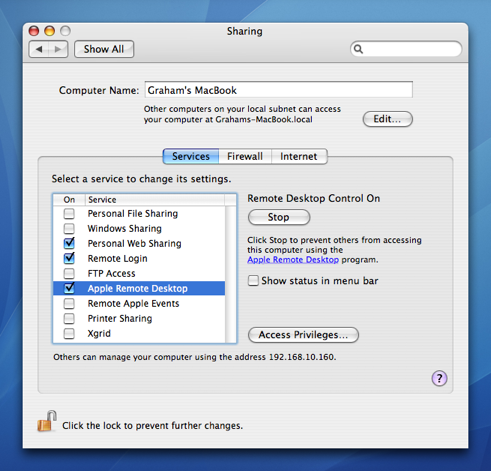
- Go to System Preferences > Sharing
- Select Remote Login.
- Choose which users you want to have remote access or the ability to control your Mac.
You can either select All Users, which means any other device on your network, or any Mac you own, can access and connect, or click the plus sign to pick the exact users.
When you want to remotely log in to your Mac from another device, you need to know your username (the name that appears when you login) and your computer's IP address. Write them down and keep them safe, as allowing access to your Mac does make it potentially less secure, especially over cellular or public Wi-Fi networks.
Accessing, controlling, or viewing information on your Mac can be done with a built-in Terminal or any other SSH app using your username and IP address.
Allow others to access your computer using Apple Remote Desktop
With macOS remote Mac access and control is even easier. To set up it:
- Go to Menu > System Preferences > Sharing
- Select Remote Management - it should appear as a checkbox.
- Now you can select who has remote desktop access. Either select, All Users, which means any other device on your network, or Mac you own, can access and connect, or click the Add button(+), which gives you the ability to select who can have remote access and/or control.
If you are using a VPN or VNC viewer and want to access your Mac remotely, you will need to setup a password first. It is also possible to use iOS devices, such as an iPhone and iPad, through Apple Remote Desktop, available from the App Store.
How to stay on the same page with Screens
Collaboration has become of utmost importance to today's workplaces. And with more and more people working remotely, being on the same screen (ahem, page) is a must.
Screens allows you to work remotely with any computer regardless of your location. Whether you are on a business trip or traveling, stay confident knowing you can access any file on your home computer at any time.
This robust screen sharing tool for Mac supports:
- Multiple displays
- Drag-and-drop file sharing
- Hiding your remote screen while accessing it
- Accessing other computers (e.g. colleague's) as a guest
- Alternative shortcuts (useful when connecting Mac to PC)
- Custom actions in case of disconnection
To start using Screens, get the app from Setapp and configure the following:
- Remote login and remote management (as per the guide above)
- Install Screens Connect helper app and create a Screens ID on every machine you'd like to connect to in the future
- Use your Screens ID in the Screens app and it will automatically determine which of your computers are available for connection
Remote desktop client for Mac
Control any computer remotely – a perfect way to access your Mac from anywhere without limitations.
Share files between devices
Today we have plenty of ways to send and share files. But ask someone to send something, and you are likely to get it through email. Due to the ubiquitousness of email, it's still the default method for file sharing, despite its obvious flaws and constraints.
Fortunately, there are much better ways:
Native macOS File Sharing
Few people know that their Mac has native file sharing functionality built in. To use this feature, activate it in the Sharing pane of System Preferences by checking File Sharing. If you only want to share specific folders, add them to the Shared Folders list. If you only want specific users to access the folder, add them to its Users list. Otherwise, everyone will be able to access it.

AirDrop
Although not the most reliable solution, AirDrop works fine for occasional sharing a file between Apple devices. In the Finder, choose Go and then AirDrop on both the sending and receiving Mac. As soon as you see the receiver's user icon, drag the desired file onto it to send.
Read more about how to use AirDrop
Dropshare
If you don't want to send files Mac-to-Mac directly but rather through a cloud storage, there is no easier way than Dropshare. The app works with numerous cloud providers, from Dropbox to Google Drive, and saves your files for sharing by simply dragging them onto its menu bar icon.
File Transfer Protocol (FTP)
The most technical but also the most robust way to share files from your mac is to use FTP, which you could do either through Terminal or an FTP Client, the latter being much more user friendly.
There are a few popular FTP clients one could choose from. The robust file managing app ForkLift covers most of the FTP functionality but takes it to the next level and could be a viable replacement for the Finder altogether with its quick search, instant previews, and file comparison.
DCommander is another full-featured file transfer app for Mac that combines speed and reliability, able to handle thousands of files, schedule backups, and even automate transfers.
At last, when it comes to sharing the same files on different devices, an app like ChronoSync Express becomes invaluable.
ChronoSync Express is powerful tool for sharing and transferring files from Mac to Mac, or any another Apple device. With a feature called Synchronizer Document, you can select which files need to be automatically synchronized and shared between devices, just like that:
- Create a new synchronizer document for each folder synchronization you'd like to perform
- Name the synchronization
- Change the Operation to Synchronize Bidirectional
- Select folders to sync on the left and right
- Test with a Trial Sync
Do you need to use a VPN (Virtual Private Network)?
Whether you are working on your Mac directly, logging into your Mac remotely, or sharing access with someone else, security should be on top of your mind.
As a rule of thumb, you should always use a VPN when connected to a public Wi-Fi network, as someone could log in and see the information you send just as easily as you do.
And with remote access — even in the View Only mode — someone can see every file and document on your Mac, except those that are password protected. Unfortunately, if you leave passwords in a visible document, you expose yourself to immense risks.
A secure VPN client for Mac like Shimo is well worth using to stop unwanted eyes from lurking around, especially if you are sharing sensitive files, financial records or customer data.
However, for extra peace of mind and security, consider firing up your VPN automatically on all networks you are not 100% sure about to keep your emails, bank accounts and personal documents safe.
To share your Mac with someone else, download a remote Virtual Network Computing (VNC) app like Jump Desktop. With full remote access and Mac remote control, the other person — or yourself connecting to another Mac — can have the same level of control as the person using that device. Except for Admin level access, since it's password protected.
Starting with Jump Desktop is easy: either yourself (gaining access) or the person you are giving a remote view or control access to your Mac, needs to add details of the device and the password.
Secure your access with VPN
Get a VPN client for Mac to avoid privacy infringement while connecting remotely. It's secure and free to try.
Once permission is granted at the other end, remote Mac screen sharing or control (whereby you can use the iOS device as a remote mouse) becomes possible.
How to use your iOS device as a remote mouse
If your remote work starts on a patio hammock somewhere in east Asia, you should note that Apple iOS devices, such as an iPhone or iPad, can be used to control a Mac remotely, much like a mouse can control a desktop or laptop. Apps that make this possible work on VNC.
Remote Mouse is the easiest, most effective way to turn your iOS device into a wireless remote control for your Mac.
Although remote access through a local network would be most effective, since the closer you are to the device the quicker the connection, it's also possible from anywhere in the world, providing the network is secure and fast enough.
Setting up and granting access to the iOS device is the same process as when someone wants to access using a Mac. Except you need to give them a password. And make sure it is different from your primary Mac or iOS (App Store) one.
So working together or checking on your devices can be done from anywhere in the world and there are lots of ways to do that, from sharing screens and files to having complete access to a system set up far away. Setapp equips you with all the apps needed to remotely access any device you need and elevate your work to the global level.
These might also interest you:
Meantime, prepare for all the awesome things you can do with Setapp.
Read onSign Up